Table of contents

Why a Power Bank Stopped Being Optional for Me

My phone has never lasted a full day without help. I study, work, and also actively make content on instagram, so the screen is on from the morning until I go to bed. Add a pair of earbuds that need their own top ups, and one badly timed power cut, and a wall socket becomes the most valuable thing in the room.

If you live in Pakistan, you probably know the feeling. Your phone drops to 5%, the lights go out, and the nearest working socket is somewhere you can't reach. A power bank stopped being a nice extra for me a long time ago. It's just part of the bag now.

One thing I should say upfront: I work on FASTER's content, so I'm not a neutral outsider. What I can promise is that everything below comes from personal testing and feedback from the technical team at FASTER.

Safer Power. Longer Life.

Safer Power. Longer Life.

Shop

The FASTER Power Core suits anyone who relies on a power bank every day and wants a battery that holds up over time, with a semi solid cell and three output ports for Rs 8,720.

  • 20,000mAh capacity, enough for 3 to 4 full charges on a typical phone
  • Semi solid battery rated for 2,000+ charge cycles
  • LED display and a flight friendly design for carry-on travel

The Three Power Banks I'd Look at Under 10,000 Rs

All three cost well under 10,000 Rs. After that, they have very little in common, so here's how I see each one.

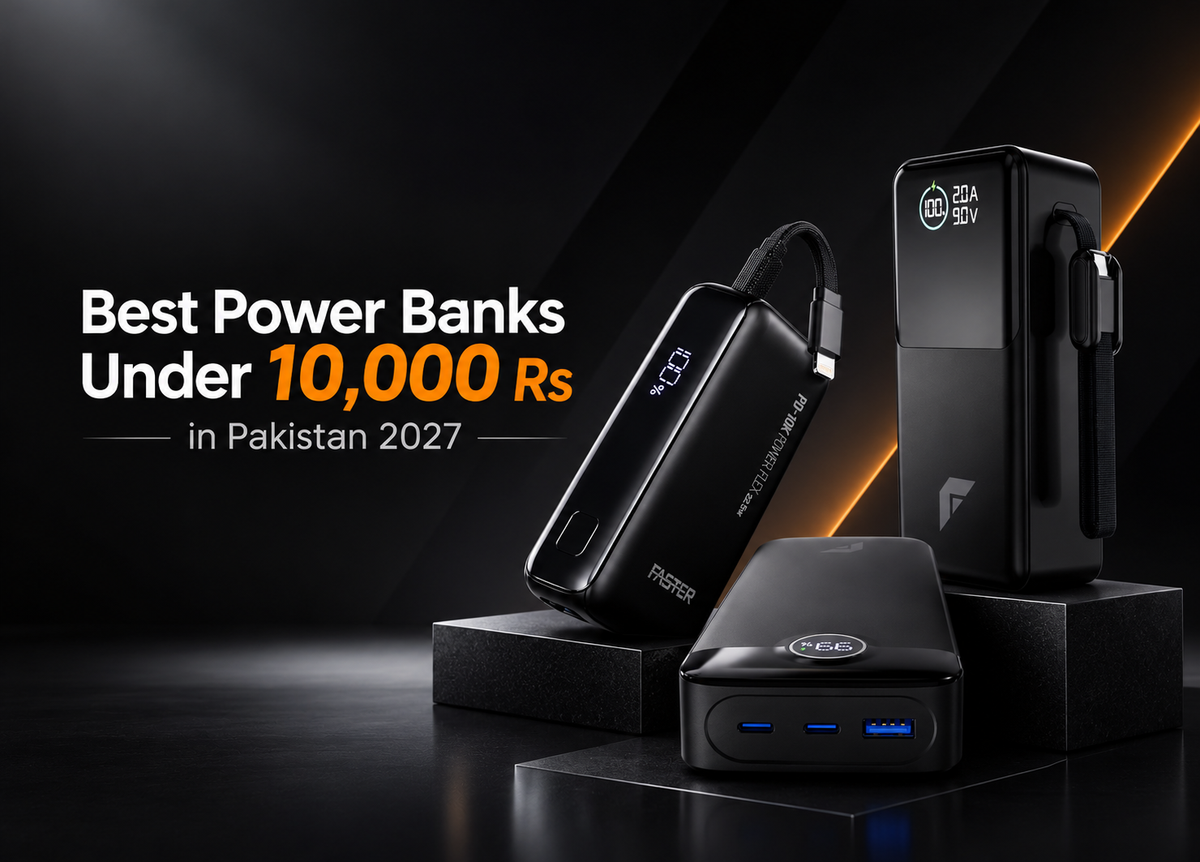
  1. Power Core Power Bank (Rs 8,720): A 20,000mAh power bank with a semi solid battery, which uses a gel based electrolyte instead of the liquid one found in most power banks. It has three output ports (two USB-C and one USB-A) and each one supports 20W fast charging. FASTER rates the battery for 2,000+ charge cycles, and a Type-C cable comes in the box.
  2. PowerViz 30K Power Bank (Rs 8,530): The biggest battery in the range at 30,000mAh. Output maxes out at 22.5W. You get a USB-A port, a USB-C port and a Type-C cable that's already attached, so three devices can charge together. The screen goes beyond a battery percentage and also shows voltage and current. One more detail I like: you can plug the power bank in to recharge while it's still charging your phone and it is the case with pretty much all the models.
  3. Power Flex PD10K (Rs 5,690): A 10,000mAh option with 22.5W QC fast charging and built in Type-C and Lightning cables. It's the one I'd hand to a friend who just wants something light that works with both Android and iPhone, with no extra cable to remember.

You can see all of them in FASTER's power bank collection.

Honest Comparison

Specs on their own don't help much, so here's what each one actually gives you, including what it doesn't.

Model Capacity Key Features Best For You If Price
Power Core 20,000mAh Semi solid battery, 20W fast charging on all three ports, 2,000+ charge cycles, LED display You want a battery that stays safe and ages well with daily use Rs. 8,720
PowerViz 30K 30,000mAh 22.5W QC fast charging, USB-A, USB-C and built in USB-C cable, display with percentage, voltage and current You need several days of backup or charge more than one device Rs. 8,530
Power Flex PD10K 10,000mAh 22.5W QC, attached Type-C and Lightning cables, LED display You'd rather carry something small and spend less Rs. 5,690

Rs 190 separates the Power Core and the PowerViz 30K, so price won't settle this one. Ask yourself whether you'd rather have a long lasting battery or an extra 10,000mAh.

One Charge. Days of Backup.

One Charge. Days of Backup.

Shop

The FASTER PowerViz 30K suits anyone who travels or charges several devices a day, with the largest battery in the range and a cable that’s already attached, at Rs 8,530.

  • 30,000mAh capacity for phones, tablets, earbuds and smartwatches
  • 22.5W QC fast charging with USB-A, USB-C and a built in USB-C cable
  • Smart display showing battery percentage, voltage and current

A Smart Buyer's Guide

I've seen a lot of people buy a power bank in a hurry and regret it a month later. A few minutes of checking saves that.

What to Check Before Buying

Everyone looks at mAh first, and that's a fair place to start. As a rough guide, 10,000mAh means two phone charges, 20,000mAh means three or four, and 30,000mAh gets a few devices through a whole weekend. Check the watts too. mAh only tells you how much is in the tank, while watts tell you how fast it pours out.

Features Worth Having

  • Protection against overcharging, overheating and short circuits
  • A display that shows what's left, so you aren't guessing
  • Enough ports for the devices you really carry
  • A cable situation that suits you, either built in or in the box

Is Paying More Worth It?

Here's some maths I did while writing this. The Power Core costs about Rs 2,840 more than the Power Flex PD10K, and the PowerViz 30K costs about Rs 3,030 more. For that, you get double or triple the capacity. If you only charge your phone once a day, the PD10K is probably enough. If you've ever been stuck in a long day with a dying phone, the extra spend starts to make sense.

Common Mistakes

  • Buying an unbranded power bank with no warranty
  • Trusting a big mAh claim without checking the output
  • Ignoring safety protection because the price looks good

However, if you want a proper guide on how to choose the right power bank, I would suggest reading this piece as it has everything that there is to know.

No Cable. No Fuss.

No Cable. No Fuss.

Shop

The FASTER Power Flex PD10K suits anyone who wants a light daily carry that works with both Android and iPhone, with both cables built in, at Rs 5,690.

  • 10,000mAh capacity, about two charges for most phones
  • 22.5W QC fast charging
  • Built in Type-C and Lightning cables, so nothing extra to carry

Real Problems You Face and How the Right Power Bank Helps

A power bank that slows down after a few months is a common complaint, and battery quality is usually the reason. This is where the Power Core's semi solid battery matters. FASTER rates it for 2,000+ charge cycles, which is far more than what people usually expect from a standard unit.

Another issue is carrying a power bank and then finding out you forgot the cable. The PowerViz 30K and the Power Flex PD10K both have built-in cables, so that problem disappears. And if you charge a phone, earbuds and a tablet on the same day, the multiple ports on the Power Core and PowerViz 30K save you from taking turns.

Which Power Bank Is the Right One for You?

There's no single answer here. Your routine decides it.

  • You carry a phone and earbuds and want something light and cheap: go for the Power Flex PD10K.
  • You use your devices heavily every day and care about safety and long term battery life: choose the Power Core.
  • You travel, or charge several devices and want days of backup: pick the PowerViz 30K.

Conclusion

If I had to pick one, it'd be the Power Core. At Rs 8,720 it gives you 20,000mAh, three output ports and a battery rated for 2,000+ cycles, and it's the one I'd feel comfortable leaving in my bag every day. If capacity matters more to you than anything else, the PowerViz 30K at Rs 8,530 is the better buy for almost the same money. Budget tight? The PD10K at Rs 5,690 still covers the basics.

Think about your own day before you pick, because that matters more than any spec on a box. You can compare all three in FASTER's power bank collection.

FAQs

Which is the best power bank in Pakistan under 10,000 Rs?

It depends on how you use it. For daily use and long term battery health, I'd pick the FASTER Power Core at Rs 8,720. For maximum capacity, the PowerViz 30K at Rs 8,530 is stronger, and for a light and affordable option, the Power Flex PD10K at Rs 5,690 is the one to look at.

How many mAh is good for a power bank?

For a normal day with one phone, 10,000mAh is plenty. I'd step up to 20,000mAh if your days run long or load shedding hits often. 30,000mAh makes sense when you're travelling or sharing the charge with other devices.

Does higher mAh mean faster charging?

No. mAh is how much the power bank stores, and speed comes from watts. The Power Core runs at 20W and the other two at 22.5W. So the PowerViz 30K stores three times what the PD10K does, but it won't fill your phone any quicker.

How do I choose the right capacity power bank for my needs?

Start with your phone, since most batteries sit between 4,000mAh and 5,000mAh. Then decide how many refills you want between wall sockets. One or two? 10,000mAh does it. Three or four? Go for 20,000mAh. Anything more, or if you're charging for other people too, 30,000mAh is the safer choice.

Do these power banks support fast charging?

Yes. The Power Core supports 20W fast charging on all three ports, while the PowerViz 30K and Power Flex PD10K support up to 22.5W QC fast charging. All three work with Android phones and iPhones, though the real speed depends on what your phone accepts.

Aun Haider

Aun Haider

SEO Content Writer

Aun Haider is an SEO Content Writer at Faster Pakistan, specializing in SEO-driven content, copywriting, and creating content that connects with audiences. Beyond his professional role, he is a curious, creative, and people-oriented individual who enjoys travelling, exploring new ideas, telling stories, and bringing a fresh perspective to everything he creates. Connect with him on Instagram, LinkedIn, and Medium.

Latest Stories

View all

 Compact Power Banks Offer Advanced Charging Features

What Compact Power Banks Offer Advanced Charging Features?

Small no longer means slow. Compact power banks now come with PD fast charging, magnetic wireless and built-in cables, and the FASTER models show how far that’s gone.

Read more

Best Power Banks Under 10,000 Rs in Pakistan: 2027 Guide

Best Power Banks Under 10,000 Rs in Pakistan: 2027 Guide

I went through three of the very best FASTER power banks that cost less than 10,000 Rs: the Power Core, the PowerViz 30K and the Power Flex PD10K. Below you'll find who each one suits, what it costs, and where it falls short.

Read more

How to Use a Power Bank for the First Time

How to Use a Power Bank for the First Time

New to power banks? This guide walks through the first charge, connecting your devices, the slip-ups beginners make, and how to keep the battery healthy. It also points you to the Faster model that suits your routine in Pakistan

Read more